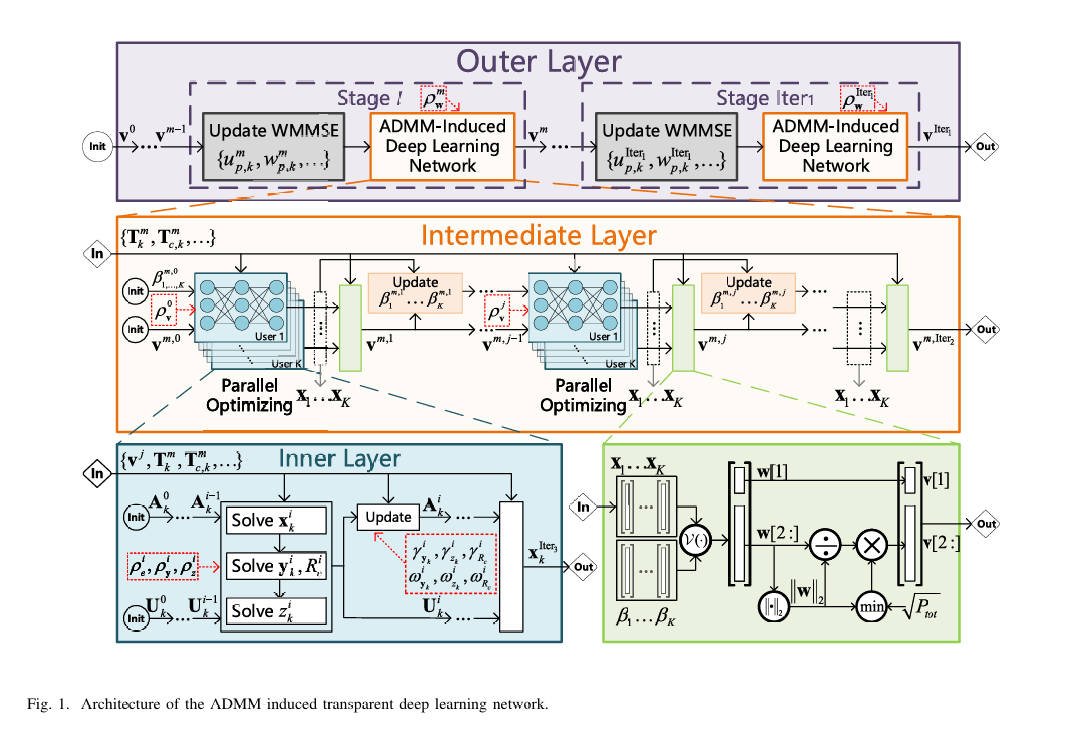
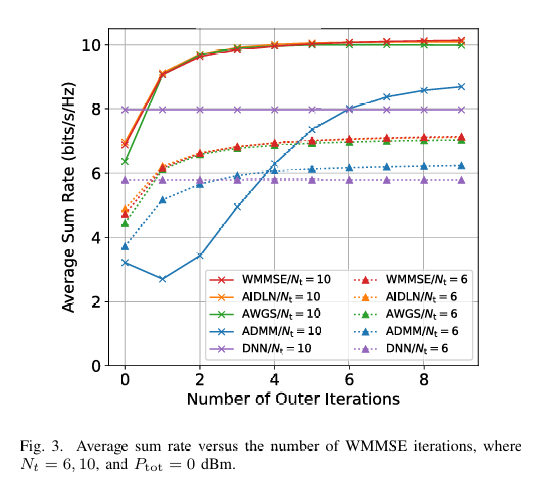
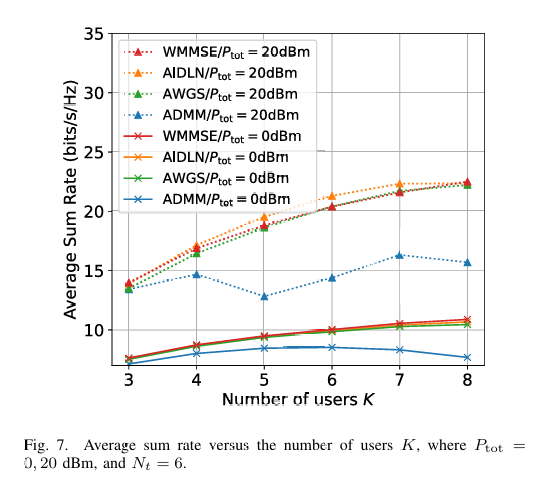
**Abstract**:The non-convexity of rate-splitting precoder design precludes the direct use of efficient convex optimization algorithms. Instead, successive convex approximation (SCA) based methods have emerged as a promising approach for precoder design in rate-splitting multiple access (RSMA) systems. Although SCA-based algorithms deliver satisfactory performance, their lengthy optimization process and high computational complexity—due to repeatedly solving approximate problems—hinder real-time implementation. To address this challenge, we propose an alternating direction method of multipliers (ADMM)-induced deep learning network (AIDLN) based precoder design for multiuser downlink communications, leveraging the strengths of both model-based optimization and data-driven deep learning. Specifically, we first develop an iterative precoding algorithm based on ADMM, where each subproblem admits a closed-form solution. Next, we unfold the iterations of this ADMM-based algorithm into the layers of a neural network, constructing a deep-unfolding architecture. To accelerate convergence, we introduce trainable parameters alongside the ADMM hyperparameters. Numerical results demonstrate that our AIDLN-based precoder achieves superior performance compared to traditional model-based optimization while maintaining low computational complexity, making it suitable for real-time applications. **Index Terms**:Deep learning, rate splitting multiple access, deep unfolding, alternating direction method of multipliers, precoder design.
Recommended citation: Wang, Chao, et al. "Toward Transparent Deep Learning_Neural Precoder Design for Downlink RSMA" IEEE Transactions on Communications (2025).
Download Paper